
Evolution in the field
(Image above - North Slope, Alaska - after 45 minutes of digging a complete mammoth femur out of permafrost. (And we didn't even really want it - but it was just too nice to walk past).
My career has been built around fieldwork - collecting animal and plant, sediment and water samples from interesting places and developing new ways to extract detailed genetic signals from them. My aim is to study how change occurs through time, and to reconstruct past environments and what that can tell us about the events at the time. I started my research in New Zealand as a mad cave explorer, during which I would often find bones of extinct birds, including the giant moa. An encounter with fellow kiwi Prof. Allan C. Wilson in 1989 got me an invitation to UC Berkeley to work with Svante Pääbo, where I performed some of the first ancient DNA studies, and pioneered the field standards for ancient DNA. However, I regard ancient DNA as just a tool and my main interest has always been to tackle big picture questions, using research that spans multiple disciplines and focuses on unconventional approaches. I have an unusually broad background that ranges across evolution, climate change, palaeontology, genetic dating, environmental science, human evolution and genomics, microbiology, and geomagnetism amongst other areas. I specialise in building international multi-disciplinary teams of experts to address major scientific questions. Recent examples include the potential role of geomagnetism and solar weather in evolution (listen to the Adams Event podcasts at the link above), human evolution and medicine, and the impacts of climate change.

Ancient DNA
My specific area of expertise is ancient DNA and my PhD work was performed with Svante Paabo and Allan C. Wilson, who pioneered the ancient DNA field, at UC Berkeley in 1989. My PhD involved some of the first experiments that confirmed that DNA could survive in sub-fossil bones rather than just preserved soft tissues (mummified skin, hair etc), which was the general assumption at the time (Cooper et al. PNAS 1992). I showed that the DNA preserved in bone was much better than soft tissues, and this work opened the way to the genetic analysis of the vast museum collections of bones (that aren't truly fossilised). This was a major advance - and I spent much of the next decade in the back rooms of museums looking for well preserved bones from interesting species - at first ancient birds, and then ancient mammals, and finally humans.
Environmental DNA
In addition to analysing animal and plant fossils, I have also developed a number of methods to analyse traces of genetic material preserved in modern and ancient environmental samples - ranging from ancient sediments, ice and permafrost, water (fresh and marine), to cave calcite formations. The amount of surviving genetic material is generally tiny, and establishing standards for laboratory methods has been a constant theme. In the case of Antarctic ice (pictured) around 5-6 litres of 130,000 year old ice were filtered in the field, in order to filter out enough micro-organisms and DNA to generate reliable signals. My environmental DNA research has included ancient humans, animals, plants, invertebrates, and microbes (fungi, bacteria and viruses).
Image above - trying to melt 100,000 year old ice cores in a tent in the middle of Antarctica! I used bin liners to trap sunlight. It worked! (Heath Robinson would be pleased).

Aboriginal Heritage Project
In 2014 I successfully obtained ARC funding to develop and lead the Aborginal Heritage Project (AHP), a major collaboration with Indigenous families and communities across Australia and the South Australian Museum, to reconstruct the genetic history of Australia prior to the arrival of Europeans. The AHP is based on the generation of genetic sequences from historic hair samples held at the South Australian Museum. The hair samples were collected in a series of anthropological expeditions across Australia between the 1920s and 1970s by the Board for Anthropology at the University of Adelaide, led by the remarkable (and little known) Australian scientist, Dr Norman Tindale (see video below). Genetic analysis of the historic hair samples is only possible through consent of the original donors, or their descendants, and the project is built upon close participation of Aboriginal families in the analysis and interpretation of the resulting genetic data. It was a huge privilege to meet some of the original individuals in the study, as well as families and communities all across Australia. The resulting genetic map (see link below) of Indigenous Australia is designed to reconstruct Aboriginal history where written or oral records may fail, assist people from the Stolen Generation with reunification of families and Country, and facilitate repatriation of Indigenous cultural items and remains held in museums in Australia and overseas. The project has won several awards including the Australian Museum Eureka Prize (2017: photo above with Auntie Isabel O'Loughlin), and the South Australian Science Excellence Award (2018).
Website
https://aboriginalheritageproject.org
AHP Short Videos
Impact of the AHP: https://www.youtube.com/watch?v=sgCoUi9875g&list=PLrj2iJKdUdbzEicopZtCAGZ0T1M6b6zQT&index=1
Family Permissions: https://www.youtube.com/watch?v=cACI1rgNBC8&list=PLrj2iJKdUdbzEicopZtCAGZ0T1M6b6zQT&index=2
Extracting the DNA: https://www.youtube.com/watch?v=O_1U8LxMG54&list=PLrj2iJKdUdbzEicopZtCAGZ0T1M6b6zQT&index=3
Tindale/BA Expeditions: https://www.youtube.com/watch?v=xLjtVD9l_54&list=PLrj2iJKdUdbzEicopZtCAGZ0T1M6b6zQT&index=4
Media Coverage
SBS: https://www.sbs.com.au/topics/science/humans/feature/dna-country
Fieldwork
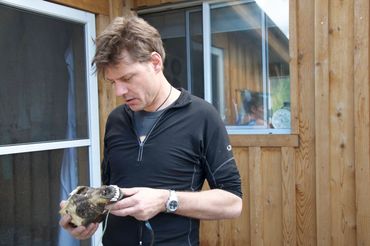
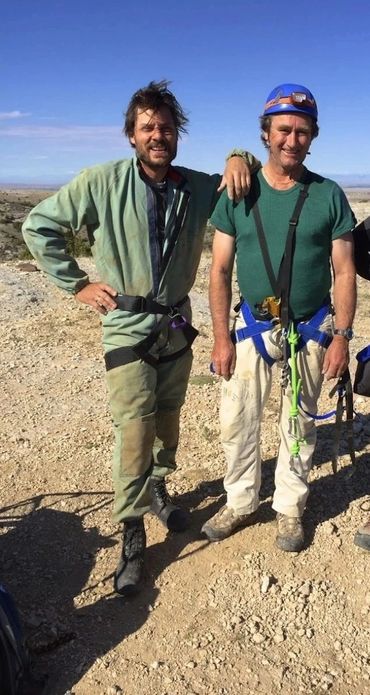


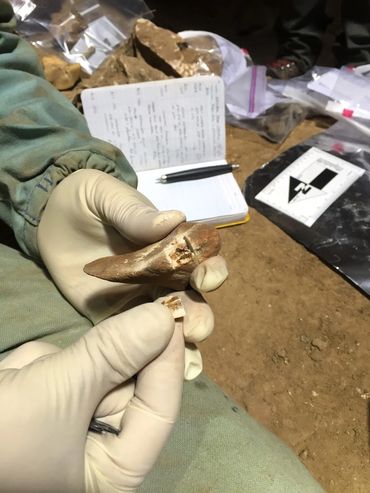

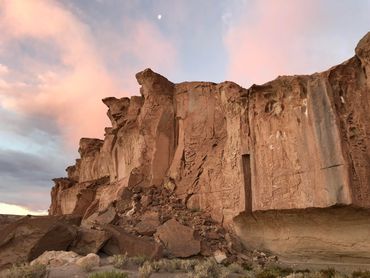
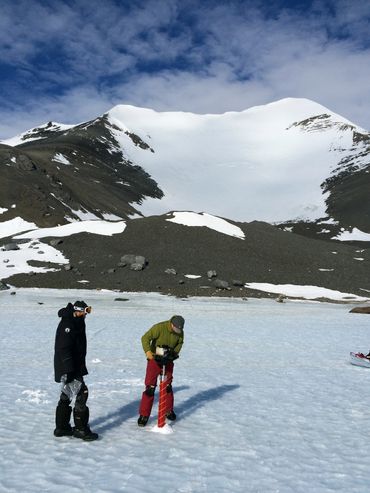
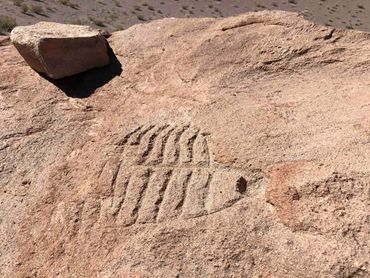
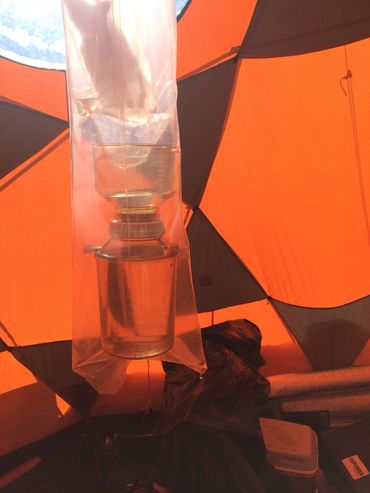
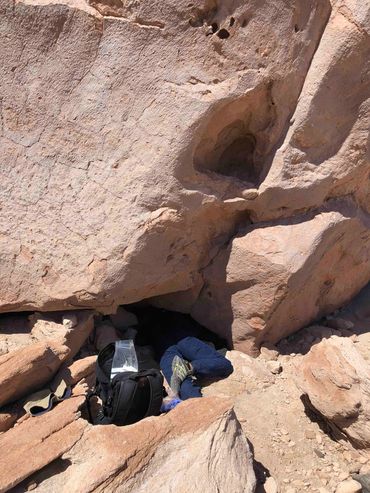
Photo Descriptions

Yukon Territory, Canada. Holocene (<12kyr) wolf skull, preserved with skin. (Trying to work out whether it was worth sampling)

Trevor Worthy - caving and paleontological guru, and great guy - above Natural Trap Cave, Wyoming. We have been caving together for >35 years!

The gated entrance to Natural Trap Cave, Wyoming. A drop of about 26m onto a rubble floor packed with Ice Age bones. Big thanks to BLM

Sampling the Flores hobbit skull for DNA with Dr Jermy Austin. Sadly, the heat, humidity and age had destroyed all DNA
Using a Dremel to sample a ~20,000 year old camel tooth, sitting on the cave floor in Natural Trap Cave, Wyoming. Note black plastic bin liner worktop.
The majestic drop into Natural Trap Cave, onto the talus pile. My background in cave exploration means I'm normally in charge of ropework safety and training for most caving trips (so far, no losses).
Atacama Desert - looking for ancient humans and megafauna. Trying hard to breathe, and chewing coca leaf!
Drilling 120,000 year old ice, Patriot Mountains, middle of Antarctica. We used the DNA to show the impacts of melting during the Eemian (the last interglacial).
Huge respect and thanks to Chris Fogwill (right) and Chris Turney (left) who got us in and out without supreme skill.
Atacama Desert - ancient carved depiction of field irrigation and subdivisions for the valley in front of us. (Paleolithic planning permissions)
Trying to melt 100,000y ice in the middle of Antarctica! I invented a hand pumped filter system to collect DNA and micro-organisms. Apparently the rhythmic squeaking late into the night was surreal in the empty and silent Antarctic interior.
Archaeologist buried waist deep in an alcove collecting ancient crop samples and animal bones, Atacama Desert

Aboriginal Community Engagement -Brisbane, with Auntie Lesley Williams. Huge thanks and respect to all our partner Aboriginal Communities across Australia