The Genetics of Climate Change

The Genetics of Climate Change

We work with international teams of expert researchers to pioneer innovative genetic and geological approaches to understand and model climate change processes and impacts, past and present. We bring together the physical, biological, and mathematical sciences to challenge standard concepts and knowledge - and better understand our world.
We focus on the big picture questions around climate and the environment, and design and apply innovative methods and approaches from across the sciences.
We work with a network of experts and field leaders across Europe, the US, and Australia - built over three decades of the highest levels of scientific research.
Proven research outcomes including over 30 Nature and Science papers, and the initiation of multiple new fields of research.
Why Blue Sky? Both because our teams focus on big picture questions, and because blue sky (a lack of clouds) is perhaps the biggest uncertainty in climate modelling. The formation, stability, and position of clouds is a hugely complex, poorly known process - yet is one of the biggest amplifiers in climate change. We are using genetic records of environmental change, past and present, and advanced climate models to pioneer conceptual change to our understanding of our planet, evolution, and life.
Climate Tipping Points are critical phase shifts in climate systems, where a sudden change in state occurs with huge impacts. Our world is currently facing multiple climate tipping points, and these changes are unlikely to be reversible in timespans relevant to our society. They include the slowing down of the Atlantic Meridional Overturning Circulation (AMOC) and the undercutting of Antarctic 'doomsday' glaciers such as the Thwaites. AMOC allows northern Europe to enjoy warm temperatures far in excess of other areas at that latitude, while the rapidly melting Thwaites will produce around a metre of sea level rise, and initiate a further 3m in quick succession.
What happens when they are passed? One of the best ways to determine where these tipping points exist, how they behave, and what will happen when they are crossed, is to examine past records. For example, the AMOC shutdown appears to be very similar to past enigmatic, extreme cold periods known as Heinrich Events, which were marked by massive armadas of icebergs rafting across the Atlantic as far south as Spain. Oddly enough, Heinrich Stadials (cold periods) were preceded by short atmospheric warming phases (which we are doing right now through Anthropogenic Warming) that are thought to raise sea surface temperatures, undercutting and lifting ice shelves, and fracturing terminal buttresses via surface melting and crevasse wedging. If AMOC shutdown and a modern Heinrich Event occurred in the next decade, it would rapidly lead to severe cold conditions across the UK and Scandanavia, with extreme weather patterns (droughts, floods) due to disruption of the jet stream, destroying agriculture (and much else) across Europe.
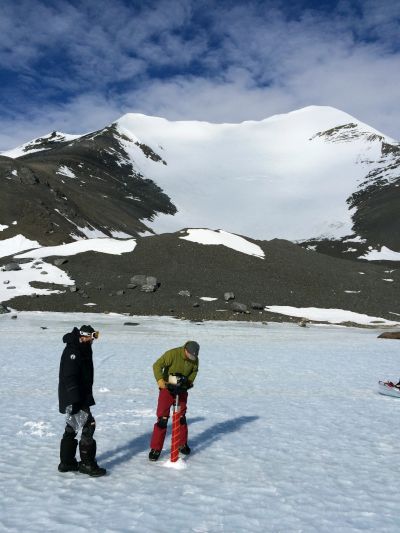
To understand this process, the amount of warming required, the speed at which the AMOC shuts off, and the processes required to start it up again we can examine paleoclimate records across multiple past Heinrich Stadials. We are currently reconstructing environmental and climate changes through these tipping points, using genetic records, Arctic and Antarctic ice core records, and marine sediment cores from around the world. This work involves global models of climate change which focus on atmospheric chemistry, ozone, UV, and the impacts of ionisation due to cosmic radiation.
Human Evolution: The climate change research is also clarifying key steps in human evolution, including the process by which modern humans left Africa in a process halted by glacial temperatures from 70-55,000 years ago. During this extended cold phase, known as Marine Isotope Stage 4, the adventurous population that had left Africa seems to have been marooned in the Arabian Gulf (then a long river valley) for over 20,000 years. During this time they underwent strong selection for the cold, dusty conditions with limited food - very much like the environments depicted in Dune by Frank Herbert (which was based on the cultures living in the area today). The genetic and cultural adaptations these first Eurasian populations underwent during this period of intense selection equipped them with the skills to finally survive the periglacial environment of Eurasia - unlike many previous attempts.